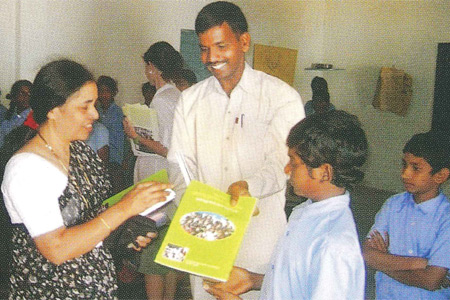
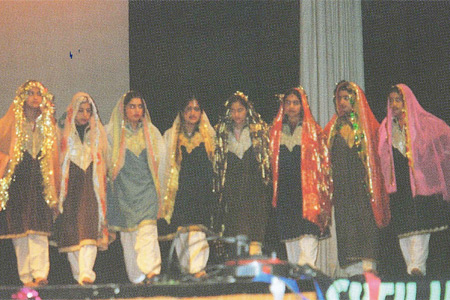
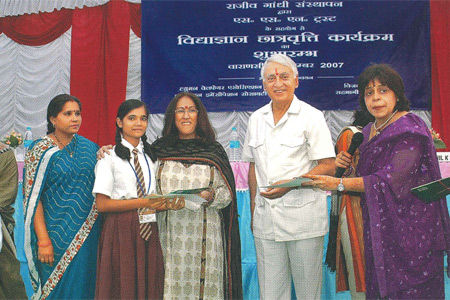
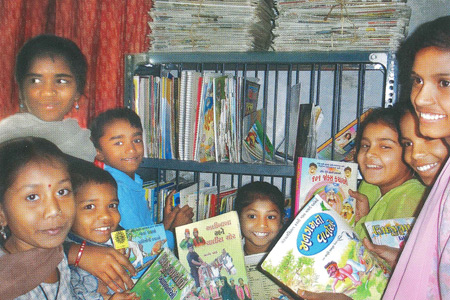
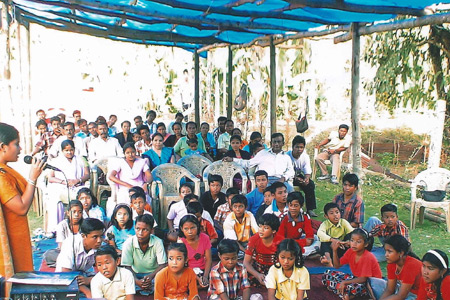
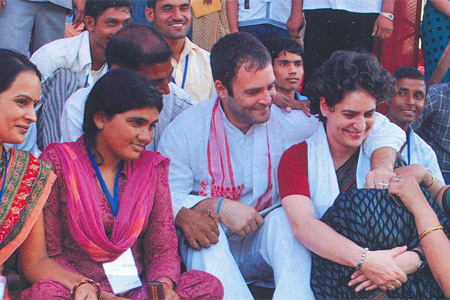
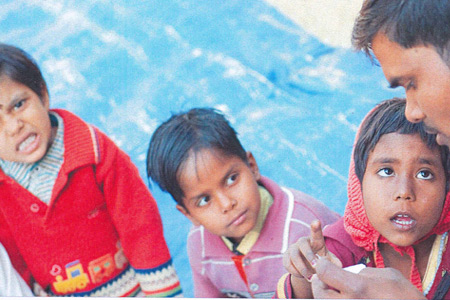
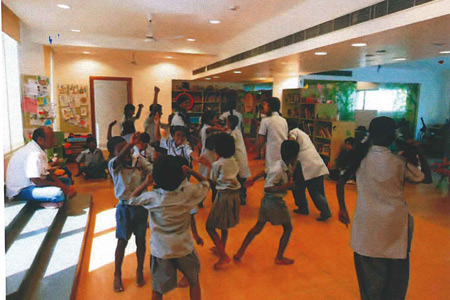
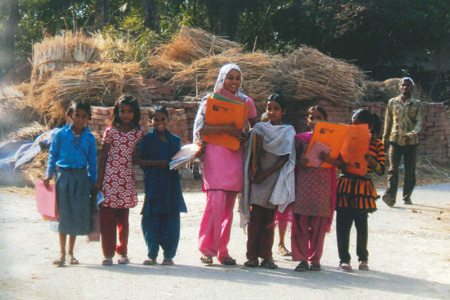
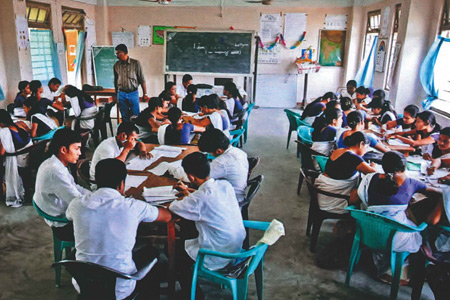
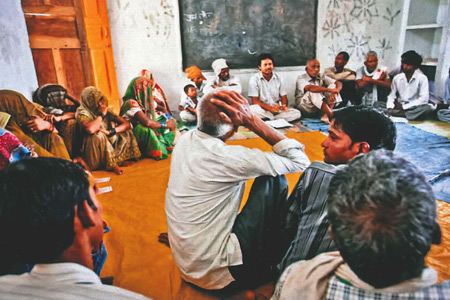
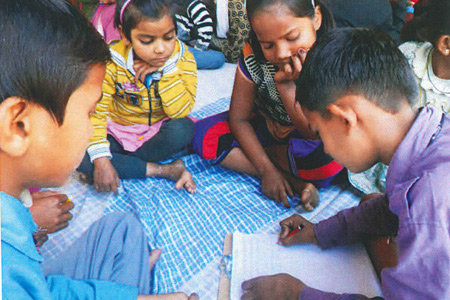
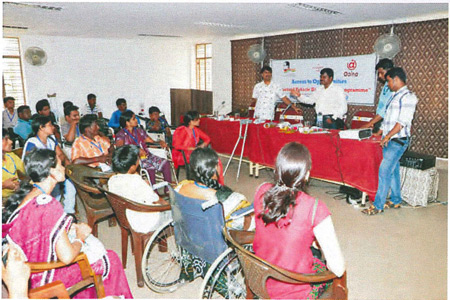
Empowerment of the underprivileged and handicapped
Promotion of excellence in aviation
Establishment of a think tank—RGICS was formed in August 1991; one of its first projects was to examine the feasibility of nyaya panchayats.
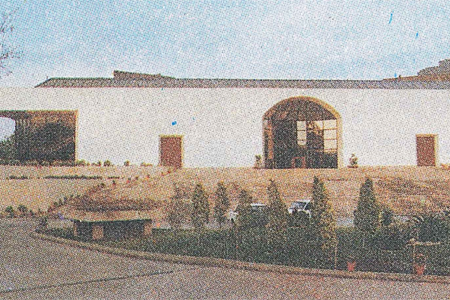
Office set up at Jawahar Bhawan, New Delhi.
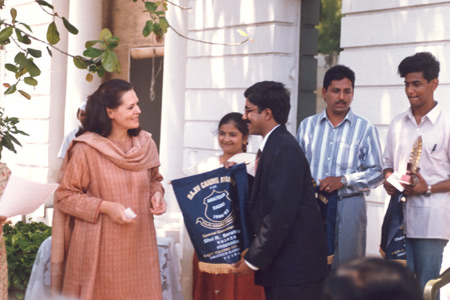
Rajiv Gandhi award of Rs 50,000 to two awardees at a debate competition at the National Law School of India, University of Bangalore. Topic of debate: intellectual property rights in the US and in India
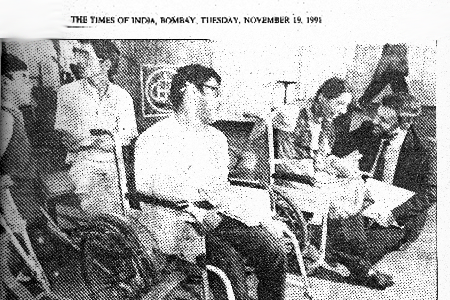
One-day seminars organised with the help of NGOs in Bombay, Madras, Calcutta and New Delhi on November 17 and 18, 1991. Aids like wheelchairs, crutches and hearing aids worth Rs 1 lakh distributed to disabled children at each of these seminars.
Literacy cell formed in January 1991; one-day seminar organised on March 7, 1992; started developing reading material for newly literate adults and to evolve a literacy programme.
Collaboration with Trees for Life to distribute fruit samplings and seeds for cultivation to rural households in many parts of India.
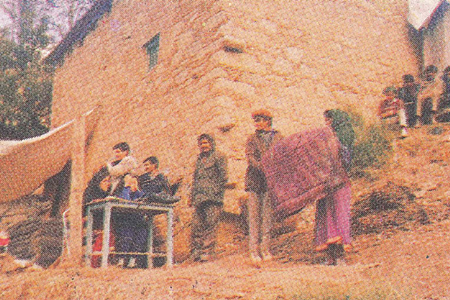
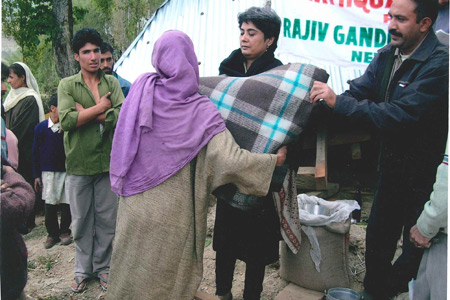
Relief to Uttarkashi earthquake victims: relief material worth Rs 5.56 lakhs donated to 100 households in the Budha Kedar block and Jatholi block.
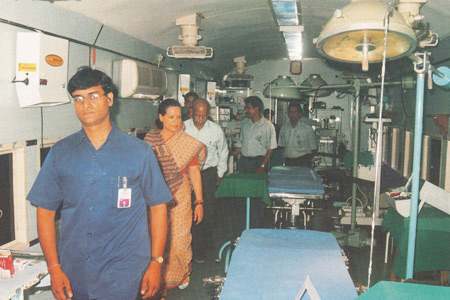
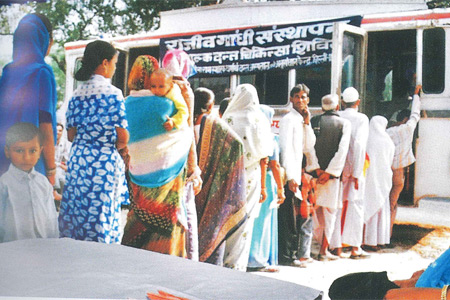
Lifeline Express developed as a concept of a hospital on a train, with stops at rural areas providing free medical care. In collaboration with the Impact India Foundation, a halt of the Lifeline Express organised in Amethi. The concept was of a hospital in a train.
Cultural and awareness programmes: Two music festivals organised in Delhi in January 1992 and in Madras in March 1992.
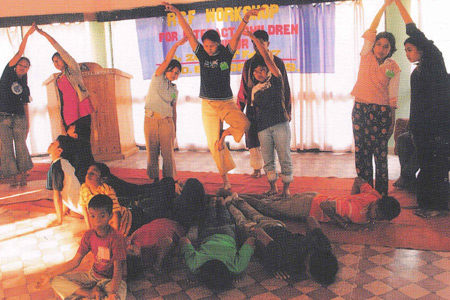
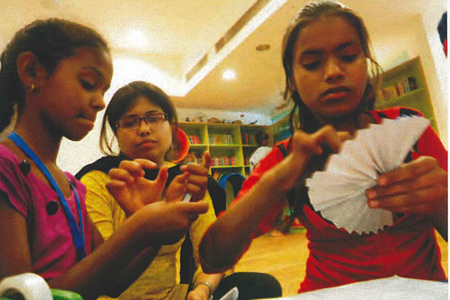
Workshop for Disabled Children
An old view of the office building, Jawahar Bhawan
Relief to Uttarkashi earthquake victims
1992-1993
Books for neo-literates: The President of India, Dr Shankar Dayal Sharma released one Hindi, two Urdu and one Telugu book from the Rajiv Gandhi Pustakmala series, which aims to develop appropriate material for neo-literates.
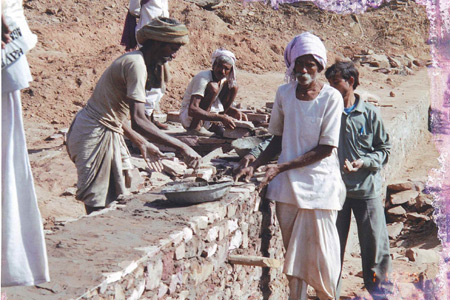
Developed prototype of earthquake-proof homes conceptualized by the University of Roorkee.
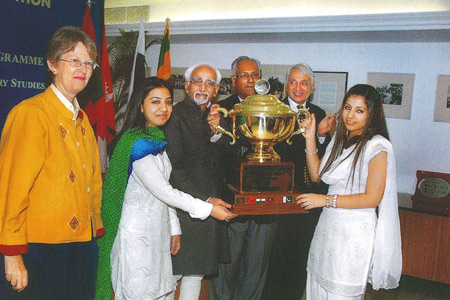
Rajiv Gandhi trophy for safest flier at Kangra, Himachal Pradesh, in April–May 1992, awarded to Ms Noriko Yamao of Japan.
Rs 4.5 lakhs allocated for the HRIDAY scheme in collaboration with AIIMS.
Five-day mobile dental camp organised to cover five tehsils of Amethi constituency in August 1992, which benefitted 1,867 patients.
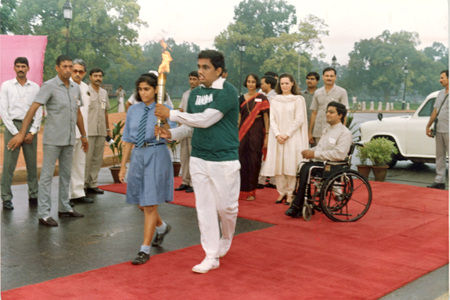
Rajiv Gandhi Walkathon, a run from India Gate, organised on August 20, 1992; more than 3,500 children participated.
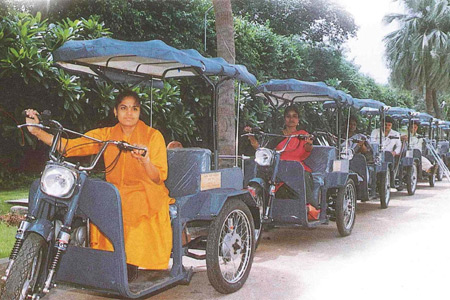
Scheme launched to provide motorized tricycles for the handicapped.
Relief to riot victims in Bombay, Calcutta, Bhopal, Hyderabad, Munger and Kanpur where tarpaulins, blankets, medicines and cooking utensils were distributed; the Foundation also provided Rs 10 lakhs for emergency relief to victims of riots in Bombay.
Special project for children of victims of terrorist violence set up with an initial contribution of Rs 25 lakhs.
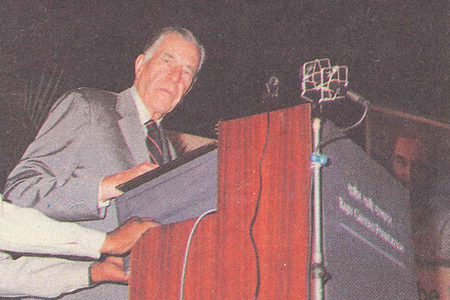
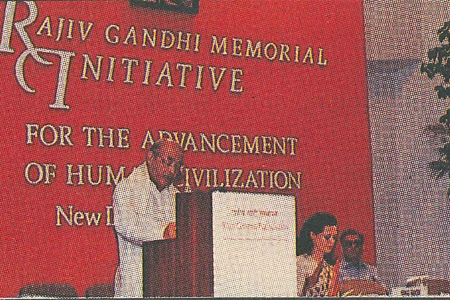
First Rajiv Gandhi Memorial Lecture on May 23, 1992.
Rajiv Gandhi (UK) Foundation founded on February 24, 1993, in London.
Various events and music festivals organised in Delhi and Bombay for fund raising; Rs 4 lakhs collected from these events donated towards relief to riot victims.
Mr. Robert S. McNamara – Former World Bank President speaking at the First Rajiv Gandhi Memorial lecture on May 23, 1992
RGF Started a Project to Develop Prototype of an Earthquake Proof Home
1993-1994
Interact (Initiative to Educate, Rehabilitate and Assist Child Victims of Terrorism) was promoted extensively, reaching out to over 150 children from the states of Assam, Punjab, Andhra Pradesh and Jammu & Kashmir. In addition to the Rs 25 lakhs corpus, another Rs 2.9 lakhs were contributed by Smt. Sonia Gandhi for Interact. The Foundation also launched a Sponsor a Child programme under Interact, the cost of one year’s costs for a child’s education being Rs 10,000, and of supporting one child continuously Rs 60,000.
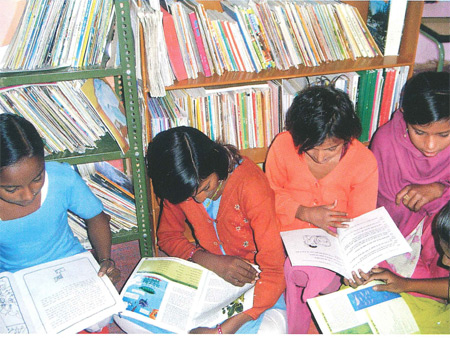
43 rural libraries set up by March 1994; nine new books released in the Rajiv Gandhi Pustakmala series.
Health Projects :
Lifeline Express sponsored in Maharashtra and Tamil Nadu.
HRIDAY launched in June 1992 in collaboration with AIIMSl reached out to 47 schools in Delhi and its suburbs
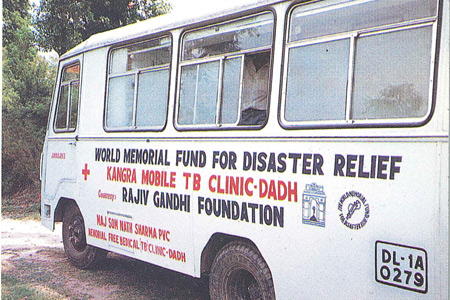
TB mobile van
AIDS awareness programme
Welfare programmes for the disabled:
Distribution of motorised tri-wheelers to talented persons with an orthopaedic handicap
Projects on disability awareness in West Bengal and Mizoram
Rehabilitation unit at Akshay Pratishthan, New Delhi
Opening of a Braille library at Rae Bareilly
Presentation of a Swaraj Mazda to Amar Jyoti School, New Delhi
Seminar on multiple disabilities in December 1993 at Madras
Seven-day painting exhibition by disabled children to commemorate the 49th birth anniversary of Shri Rajiv Gandhi in New Delhi
Task force on Panchayati Raj organised various workshops for panchayat development in Patna, Madras and Lucknow.
Rajiv Gandhi Memorial Lecture on May 1 and 2, 1993, in New Delhi.
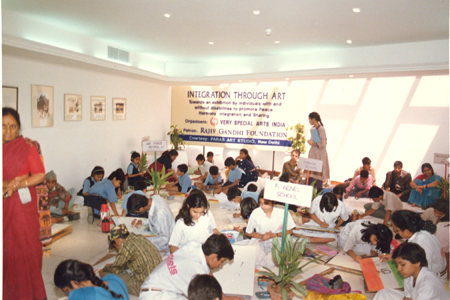
Integration Through Art
Rajiv Gandhi Walkathone
Rajiv Gandhi Memorial Initiative for the Advancement of Human Civilisation
1994-1995
Task force on Panchayati Raj
Five meetings held to take stock of the situation relating to enactment of new acts or amendments of the existing state acts for panchayats.
Regional workshop on traditional self-governing institutions for north-eastern regions held in Guwahati.
A Charter for the Panchayats’ finalised and released on the 50th birth anniversary of the late Shri Rajiv Gandhi.
1995-1996
Programmes for women and children:
INTERACT initiated with Rs 25 lakhs donation from Smt. Sonia Gandhi.
Project REACH
Aid to Bhopal gas tragedy victims
Training package for preventive work with children of alcoholics
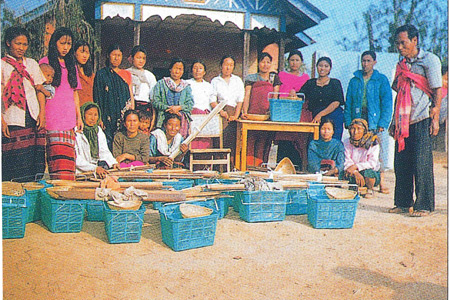
Training for tribal women
Health Programmes:
Mobile TB clinic
Rajiv Gandhi primary healthcare project
Rajiv Gandhi Foundation’s crusade against AIDS
Lifeline Express project
Programmes for the welfare of disabled people:
Motorised tri-wheeler scheme gave away 10 vehicles to physically challenged people
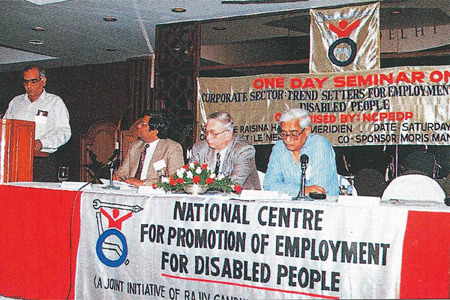
National Centre for Promotion of Employment for Disabled People
Hand-rickshaw puller project in Mussoorie
Science and technology for development:
Development of barefoot technicians for livestock management
Mobile veterinary clinics
The RGF Amateur Club
Rajiv Gandhi Biomass Energy Project for a sustainable irrigation system for rural development
Design and technology project initiated to initiate young students
Programmes for literacy:
Mobile libraries and books for neo-literates
Rajiv Gandhi Initiative for Elementary Education and Empowerment of the Girl Child
Education encouraged among tribal girls of Udhampur district, Jammu and Kashmir.
Seminars and lectures:
Prof. Manmohan Singh, former Finance Minister of India, delivered a lecture on “Economic Reforms: The Task Ahead” in 1995
Shri P.A. Sangma, former Minister of Information and Broadcasting, delivered a lecture on “Reforms in Labour sector and Employment Situation” in 1995.
The Foundation also organised seminars, discussion meetings and conferences during the year on mental health, tribal matters, and equity in global society.
Publications during the year included ‘The Future of the World Bank’, ‘Democracy and Human Rights’, ‘Technology Missions’, and ‘Hindu Muslim Riots 1960–93’.
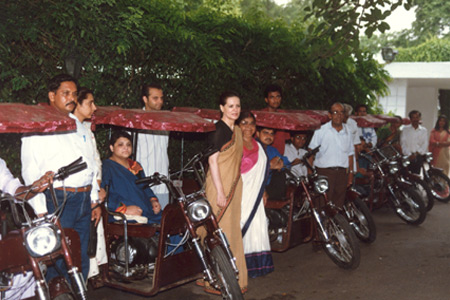
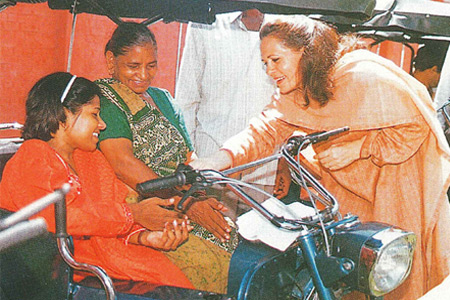
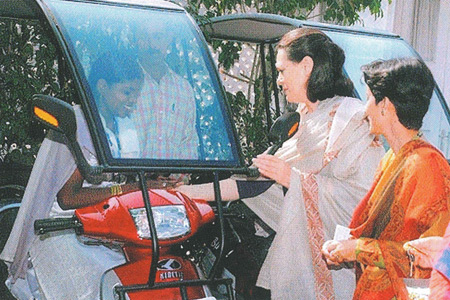
Distribution of Tri Wheeler by Sonia Gandhi
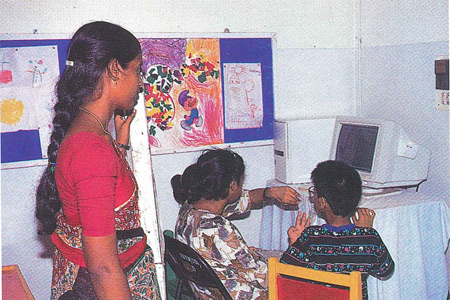
Spastic Children Working on the Computer at Chennai Centre
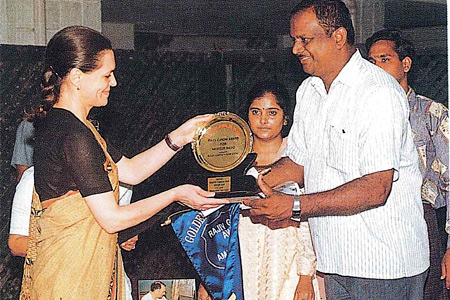
Annual Rajiv Gandhi Ham Radio Award Ceremony
Mobile TB Van at Work in Kangra HP
1996-1997
Health Programmes:
Workshops for generating awareness against AIDS; mobile aids counselling
Health for All: community-based primary healthcare models implemented in 32 villages in four blocks of Amethi tehsil
The Foundation provided over 100 cycle rickshaws to remove hand-pulled rickshaws from Mussoorie; in view of the fact that most rickshaw pullers were already suffering from TB and other diseases, the Foundation organised a health coverage scheme funding medicines for identified TB victims
Primary healthcare project launched in 1995 in Allahabad district to provide healthcare delivery through Swasthya Sakhi Yojna, using Ayurvedic and herbal medicines
Annual dental camps in Uttar Pradesh
The Foundation mobile TB van working in Himachal Pradesh since 1993
Lifeline Express expanded to eight states, covering 12 camps; relief to over 55,000 people
Literacy Programmes:
Village library project begun in 1993 grew to cover more than 550 village libraries in 10 states
Mobile libraries in four states rendering services to about 1.2 lakh readers.
Project EDGE (Educating Girls for Empowerment) implemented in Yakutpura slum in Hyderabad; 300 girls aged between 6 and 18 years taught in these educational centres
Education for 200 tribal girls in remote areas of Udaipur, Rajasthan
Rajiv Gandhi Initiative for Elementary Education (RGIEE) launched in Madhya Pradesh: (1) 10 schools in Sehore district started; 300 students enrolled; (2) 20 alternative schools set up in urban slums of Bhopal and Sehore; (3) assessment of teachers empowerment project
Three more additions to Rajiv Gandhi Pustakmala series
Women and Child development:
The Foundation sponsored one year’s training in embroidery skills and loin loom weaving to around 120 women in Manipur to enhance employment opportunities for victims of brutal ethnic violence
Vocational training for distressed women in Aizawl, Mizoram, with about 180 women trained to type, tailor and knit; their products marketed and profits distributed among members
REACH (Rehabilitation, Education and Assistance for Children on the Street) project in Indore
Project Self to develop entrepreneurship among street children in Delhi
Banjara Art and Development Centre in earthquake-hit Latur area.
Disabled assistance:
Computer training for speech- and hearing-impaired persons in Delhi
Centre for disabled children of service personnel in Udhampur, Jammu and Kashmir
Support for disabled students using specially designed software in Project CATERED.
Supported service centre for the mentally handicapped in Bhubaneswar
National Centre for Promotion of Employment for Disabled People set up in New Delhi; the Foundation provided support to the organisation for the initial two years
Science and technology:
Initiative for development of barefoot technicians trained to treat and vaccinate livestock and poultry in villages in Maharashtra, Tamil Madu, Odisha and Assam
Rs 14 lakhs donated to Doon School to establish a centre for design and technology
Others:
Rajiv Gandhi travelling scholarships in collaboration with the Cambridge Commonwealth Trust for 30 undergraduate and graduate students from various British universities
Rajiv Gandhi Archives: Data bank on Rajiv Gandhi
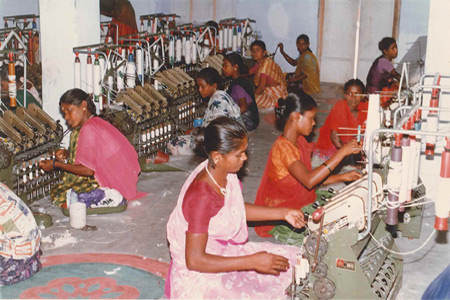
Training Programmes for Tribal Women
Promoting Employment for Disabled People
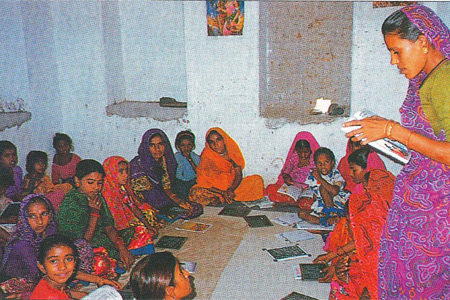
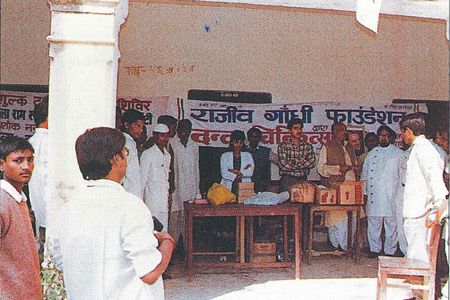
Education for Tribal Girls
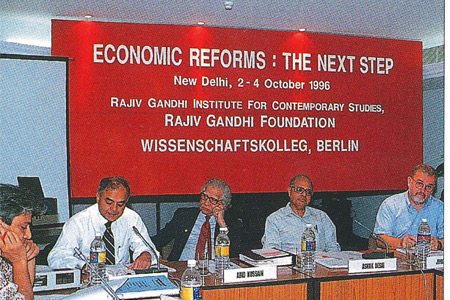
Economic Reforms – The Next Step
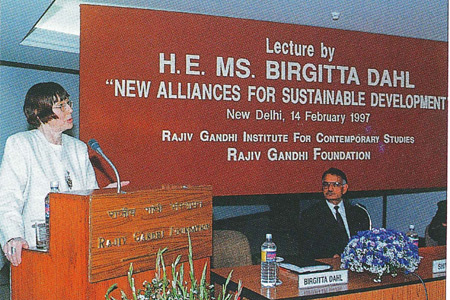
Lecture on New Alliances for Sustainable Development
RGF Organises Dental Checkup
1997-1998
Education:
Alternative elementary education project launched in Amethi in collaboration with NGO Devi
Project EDGE, which seeks to empower marginalised, slum-dwelling girl children in Yakutpura, Hyderabad
Basic education provided to 200 tribal girls aged between 6 and 14 years in Udaipur district of Rajasthan, in association with NGOs Apna Sansthan and Prayatna Samiti
Village library project expanded to cover new districts in Assam, Bihar and Uttar Pradesh (now Uttarakhand); slum libraries initiated to cater to neo-literates
To ensure that books reach a large number of people, vans provided to NGOs in Delhi, West Bengal, Maharashtra and Andhra Pradesh; these mobile libraries gave access to books to roughly 1.2 million people
Rural authors were encouraged to write and publish their work under the Rajiv Gandhi Pustakmala series
The Foundation and IGNOU signed an MoU to extend distance education programmes for higher education to Seychellois students
Welfare and empowerment of women and children:
In continuation of Project INTERACT, many children came to commemorate 50 years of independence; they participated in sightseeing, games and personality development sessions
As part of Project REACH, a third night shelter was opened
In collaboration with Sri Aurobindo Anusilan Society, tribal women from West Bengal and Bihar were trained in the production of vermicompost
Programmes for disabled People:
The Foundation collaborated with NIIT and the Spastic Society of Tamil Nadu (SPASTN) for Phase 2 of Project CATERED; the software ‘I Write Plus: An Interactive Learning Environment for the Disabled’ was tested at SPASTN
Project Lifeline Express was run in collaboration with the Impact India Foundation, with three restructured railway coaches accommodating an OT, a sterilisation room, a diagnostic centre and a 12-bed post-operative unit
Tri-wheelers were given to 30 orthopedically disabled people
An Indo-Japanese symposium on Employement Opportunities for People with Disabilities was organised to facilitate exchange of knowledge on vocational rehabilitation of disabled people
The Foundation assisted the Army Wives Welfare Association (AWWA) in the establishment of an Unit for Disabled Children of Service Personnel at the ASHA Centre, Udhampur, Jammu and Kashmir
The Foundation assisted The Chetna Institute for the Mentally Handicapped in setting up a service centre for the mentally retarded in Odisha
Science and technology:
Rajiv Gandhi Initiative for Development of Barefoot Technicians (BFT) aims at making people capable of vaccinating livestock and poultry, advising farmers on the breeding and feed management of their animals
The RGF Amateur Radio Club continued with its training courses for ham radio
The Delhi Environment Action Network (DEAN) programme assessed environmental quality in Delhi and conducted awareness campaigns to improve the environment
The Foundation Biomass Project for Rural Areas was taken into its final phase ,which was marked by the installation of tubewells, water pumps, sprinklers and pipelines
Health-related activities
The first ever training programme on HIV/AIDS in India was organised for private medical practitioners
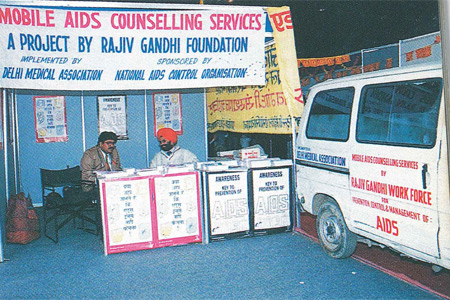
Mobile AIDS counselling services provided medical, social and psychological support to HIV patients
Another unit of the Rajiv Gandhi Home Cancer Care Services was launched, as part of which specialists visited patients on a regular basis
A model was designed to operae a community-based primary healthcare model to achieve “Health for All”. A seven-day training-cum-orientation workshop was organised for 51 Rural Health Communicators and an extended communication campaign was also launched
Medical cover was provided to rickshaw pullers and their families, most of whom were suffering from TB
Other activities:
The Foundation collaborated with the Shantiniketan chapter of INTACH for the restoration of the Jorbangla Temple of Itonda
Rajiv Gandhi Chair on Panchayati Raj in Gandhigram Rural Institute in Tamil Nadu addressed research projects and brought out a number of publications on the distribution and function of powers in the Panchayati Raj system
Rajiv Gandhi scholarships and bursaries were awarded
Rajiv Gandhi Travelling Scholarship were provided to 20 students from the UK for broader academic purposes
Started in North-Eastern Regional Centre of ACSSR, the Rajiv Gandhi Annual Lecture Series featured eminent Indians and foreigners speaking to students in the region
Media-related activities:
The ninth meeting of the RGF Board of Trustees was held on March 19, 1998. Dr Manmohan Singh, Dr Y.K. Alagh and Smt. Mohini Giri were welcomes as new trustees.
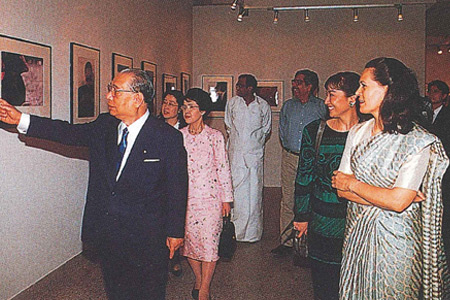
200 photographs taken by Shri Rajiv Gandhi were exhibited at the Lalit Kala Akademi Gallery from October 20 to November 4, 1997.
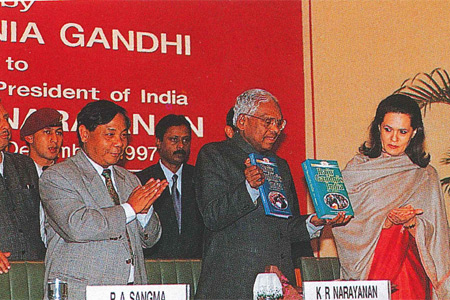
President Shri K.R. Narayanan was presented with the four-volume publication Rajiv Gandhi’s India, which covers the years of Rajiv Gandhi’s prime ministership
Strengthening the Panchayati Raj system:
The task force organised 19 sub-regional workshops and one regional workshop
The task force produced two publications: ‘The Revitalization of Panchayati Raj in India’ and ‘Voices from Below—A Summary of the Proceedings of Sub-Regional Workshops: Issues and Recommendations’.
A national seminar on panchayats was organised, which had 80 participants from across the country
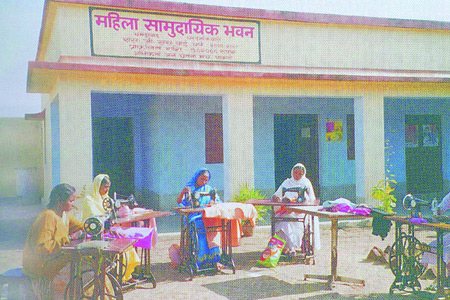
Women working under Women and Child Initiatives
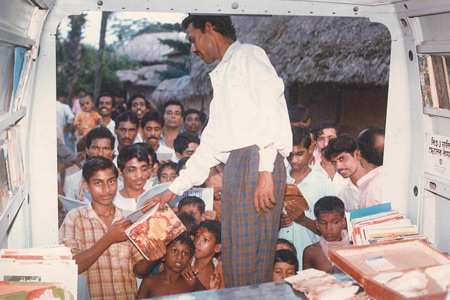
Volunteer of RGF Distributing Books Among Villagers
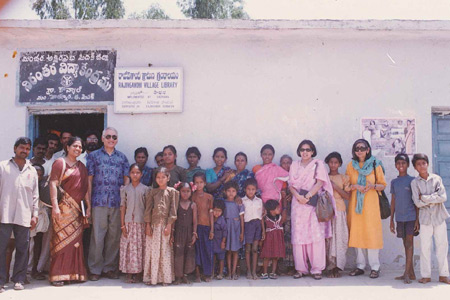
Village Library Project
Viewing the Exhibition
Smt. Sonia Gandhi Awarding a triwheeler
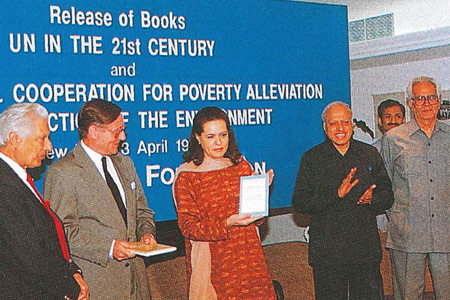
Release of Book UN in the 21st Century
RGF Awards for Best HAM Radio Operation
Presentation of the Four Volumes of Rajiv Gandhi’s India
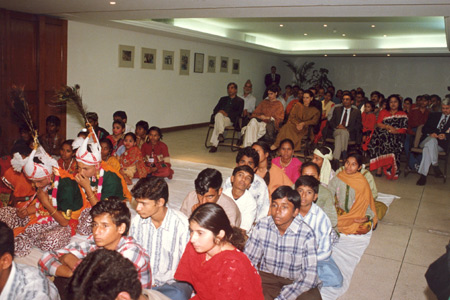
Children’s Meet
2000-2001
Literacy:
148 new libraries have been set up
Three book banks with over 5,000 books established
Four cyber centres were set up
An ‘Authors and Illustrators’ workshop was held
Adolescent girls were trained in machine embroidery as part of Project IMAGE
Health:
The Foundation supported a special clinic set up by the Lokmanya Tilak Municipal General Hospital and Medical College, Mumbai, that diagnoses and provides educational remediation to children with disability
The 25th RGF Lifeline Express camp was organised
Young people with orthopaedic disability and mild intellectual impairment were trained in sophisticated methods of modern horticulture
An Autism Awareness Programme was initiated
Women and child development:
100 children were supported as part of Project INTERACT
A programme was run that trained women to design and diversify to suit the market outside Majauli
Scholarships were awarded to encourage women to join the aviation sector
Two programmes were implemented that encouraged people to adopt ferro-cement tanks for harvesting water; groups of women were responsible for managing the tanks and distributing water
Science and technology:
An open classroom system was evolved for fishermen to facilitate two-way transfer of knowledge through group discussions
208 Barefoot Technicians were trained across different states of India
The Foundation set up a community irrigation system that uses biomass energy
RGICS:
Research papers were put on the Foundation website for review
Eight seminars and presentations were held, the main highlight being a lecture on ‘Indo–US Relations: Building a Dynamic Partnership for the 21st Century’ by Richard F. Celeste
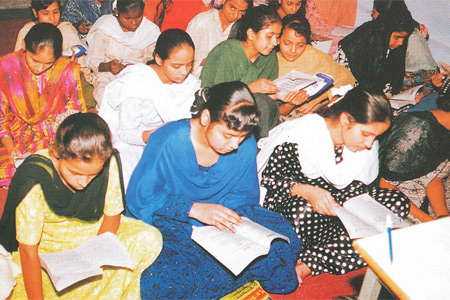
The young women pictured at the IMAGE centre defy the social taboo on female Education to empower themselves
The Mobile AIDS Counselling Clinic raises awareness about HIV AIDS through information and mass meetings
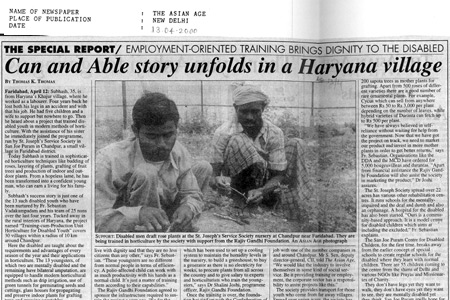
A media report by the Asian Age
2001-2002
Natural resource management:
A ‘pani padyatra’ was organised in the Bikaner tehsil from January 16 to 24, 2002.
Literacy:
36 new libraries were established in four states
Health:
A new initiative was launched in association with the Delhi State AIDS Control Society, covering two high-risk areas of Delhi—G.B. Road and Rewla Khanpur
Disabled persons welfare:
A consultation meeting was organised by the Foundation in collaboration with the Council of Architecture and the National Centre for Promotion of Employment for the Disabled to develop a blueprint for a barrier-free Delhi
Women and child development:
The Foundation collaborated with Commonwealth of Learning (COL), Canada, to develop distance-learning material for NGO staff working with street children
The Foundation worked in the Rohini area of Delhi to spread awareness on sanitation
Panchayati Raj:
A special gender-focused training module was prepared for tribal woman sarpanches in the tribal districts of Dungarpur and Banskhera in Rajasthan
A national workshop was held in Mussoorie in collaboration with Lal Bahadur Shastri National Academy of Administration, which focused on training programmes for Panchayati Raj institutions and pilot testing of training modules
Conference on terrorism:
A high-level conference was organised to discuss the implications of the United States’ war on terrorism for South Asia, particularly Kashmir
RGICS:
Research papers were published in RGICS’ International Economic Relations series
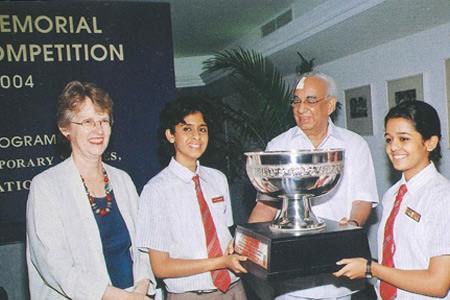
The fourth Dr Mahbub ul Haq Inter-school Debate was organised in collaboration with the UNDP to mark International Poverty Week
Awardees lined up for the motorized tri wheeler distribution
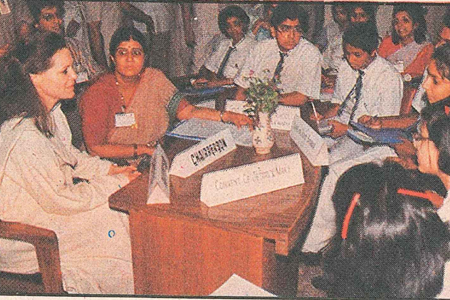
Chairperson meeting Cambridge Scholars
Health for all program in Amethi
Some Members of Green Corps on an Orientation Visit to RGF in March 2002
2002-2003
Women and child development:
A pilot project of psychological support was started in Budgam district of Kashmir
The Foundation helped NGO Karm Marg develop a new product line in wood and iron
The GINGER Project was launched in Imphal to train disadvantaged women in processing organic products as a source of livelihood
Natural resource management:
35 sites were identified for construction of water-harvesting structures; work was started in 33 and completed in 31
Health:
A project was launched in Delhi in partnership with FICCI-SEDF to raise awareness about HIV AIDS
Disabled persons welfare:
Hearing aids were distributed among children of the age group 6–16 years.
Memorial lectures, conferences and other events:
On April 3, 2002, the Foundation welcomed Indonesian president Megawati Soekarnoputri, who delivered the Sixth Rajiv Gandhi Memorial Lecture on ‘Rediscovering the Asian Identity’
The Foundation welcomed Nobel Laureate Prof. Ahmed H. Zewail to deliver the Ninth Rajiv Gandhi Science and Technology lecture on October 17, 2002
To mark the 85th birth anniversary of the Smt. Indira Gandhi, the Foundation held an exhibition of M.F. Hussain’s paintings of her
Prof. Norman Myers delivered the Fourth Rajiv Gandhi Environment Lecture on March 21, 2003
RGF’s Board of Trustees The Hon’ble Dr Manmohan Singh and Sekhar Raha
Relief Work in Kashmir for Earthquake Victims
Natural Resource Management
2003-2004
Disabled persons welfare:
The Foundation published the document ‘Accessible Delhi—A Road Map, 2003–2008’, which was taken up for implementation by the Delhi government
Revival of Lifeline Express (hospital on rails): camps held in Chhattisgarh and Uttar Pradesh
On the 59th birth anniversary of Shri Rajiv Gandhi, Smt. Sonia Gandhi presented Kinetic Honda ZX scooters to 30 individuals, 15 of whom were women
Hubert Ebner (India) Pvt. Ltd. in association with Indian Road Traffic Education (IRTE) conducted a workshop on safe driving for the disabled
A mobile van was donated to the National Association for the Blind (NAB)
Braillers were distributed to four institutions in Delhi working for the visually impaired
Two legal literacy workshops were held in the auditorium-coach of the Lifeline Express
Women and child development:
The Foundation provided financial aid to the Dr A.V. Baliga Memorial Trust, which provides training in arts and crafts and runs basic literacy classes for women ragpickers
The Foundation extended support to the NGO Concern for Humanity to provide functional literacy and tailoring skills to migrant women
Natural resource management:
In the first year of the Green Corps project in Karnataka, two residential and two regular field training sessions were organised for 15 volunteers in Bidar
In Karoli and Pali districts of Rajasthan, 16 water-harvesting structures were completed
Health:
Folk arts such as nautanki, qawwali and puppet shows were used to spread awareness on AIDS
Panchayati Raj:
The task force organised an interactive workshop from January 10 to 12, 2004, to assess the training needs of elected women PRI members
Science and technology:
A two-year pilot project was launched in Dehradun to develop and promote very small enterprises in the aromatic plants sector to enable small farmers to market aromatic essential oils
Conferences on international affairs:
A roundtable conference on ‘National Reconstruction in Iraq: What Could India Contribute?’ was held at the Foundation
A roundtable conference on ‘India and China: Global and Regional Perspectives’ was held in collaboration with the Institute for Chinese Studies
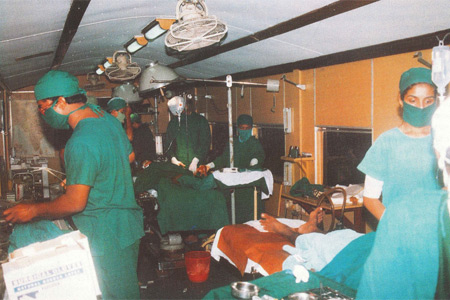
Smt. Sonia Gandhi Inspecting Operation Theatre in Lifeline Express
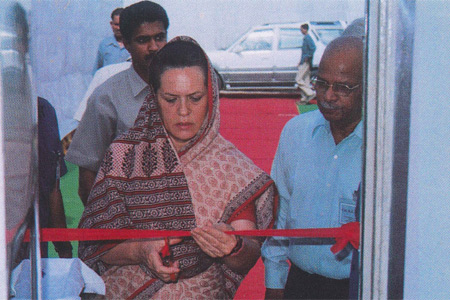
Smt. Sonia Gandhi Inaugurating Lifeline Camp
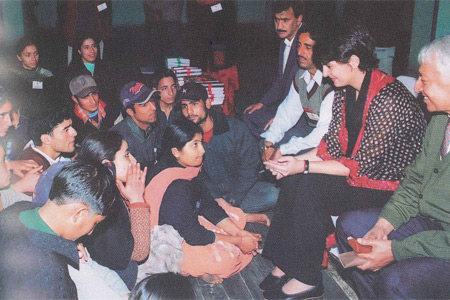
Our Trustee Smt. Priyanka Gandhi Vadra talking to INTERACT Children
Operation in progress on Lifeline Express
2004-2005
Women and child development:
Response to disaster:
Support for tsunami orphans: 118 tribal children were identified for support; the Foundation drew up plans to train about 250 psychological carers whose services were available to various communities
Child development programmes under project INTERACT:
The project sought to rebuild the lives of children who lost one or both parents in acts of terrorism
The Foundation extended help for the professional education of children who excelled at school
The Child Counselling and Guidance Centre, Srinagar, provided psychiatric care to children in a friendly and positive environment
Workshops for INTERACT children were organised using theatre, music and folk art with counselling, life skills and leadership training
Support for children affected by riots: 56 children orphaned during communal riots in Gujarat in 2002 were supported
Project REACH (Rehabilitation, Education, and Assistance to Children on the Streets): the Foundation supports three NGOs working towards the protection of street children, namely, Aarambh in Indore, Nitya Seva in Bhopal and Karm Marg in Faridabad
Women’s development programmes:
Income generation programme for women in Bokaro, Jharkhand.
Ginger processing in Imphal, Manipur
Developing skills of economically deprived women in slums of Delhi
Project Jagriti was initiated in order to combat violence faced by women
Empowering women and adolescent girls through skill development
Empowering women through self-help groups like Rajiv Gandhi Mahila Vikas Pariyojna
The Foundation has been providing scholarships to meritorious women undergoing training at Indra Gandhi Rashtriya Udan Akademi (IGRUA)
Community development programmes:
Psychological support programmes in Jammu & Kashmir
Project CARAVAN aimed at empowering disadvantaged communities through knowledge and information: some 300 students received coaching for secondary and senior secondary exams
Development of a distance-learning course on ‘NGO Management’ with material for NGO staff
Natural resource management:
The Green Corps for water harvesting established with recruitment of 41 rural volunteers
Capacity building of volunteers through residential as well as on-the-job training
Community action mobilised for water harvesting: water-harvesting structures initiated in 33 villages in nine districts of Rajasthan
Watershed development in Jamwa Ramgarh block of Jaipur district in Rajasthan: with community involvement, appropriate technology and participation of village institutions, there was 50% increase in the total crop area and 395 increase in crop yield; consequently, there was an increase in the water table
Water harvesting structures were implemented in other areas of Rajasthan as well, such as Dausa, Karoli and Pali
Watershed project in Bidar, Karnataka
Literacy:
Village and slum library project: 62 village and 76 slum libraries were established in 22 states
Initiating quality of education programmes in Jammu & Kashmir
Improved learning environment in schools, using BaLA (Building as a Learning Aid)
Girl child education under project EDGE (Educating Girls for Empowerment)
Books for children: quality books for children between 6 and 14 years developed and printed
Health:
Health planning and prevention of communicable and non-communicable diseases
Prevention, control and management of HIV/AIDS
Rajiv Gandhi Mobile AIDS Counselling Services (RGMACS) were initiated in cities like Delhi and Mumbai
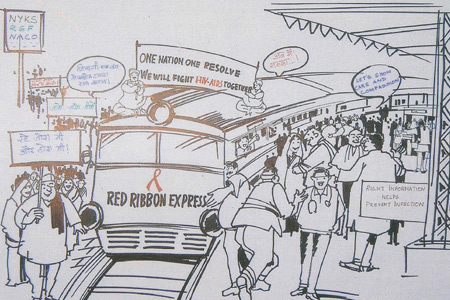
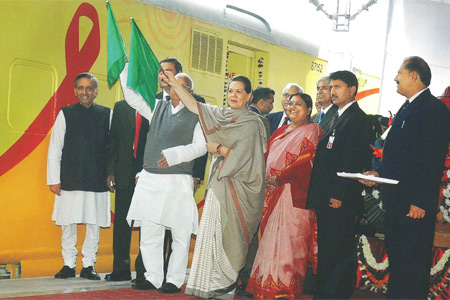
Red Ribbon Express project to check AIDS
Tuberculosis control programme
Health promotion, empowerment and development with emphasis on primary healthcare, adolescent health and policy advocacy:
Health for All strategy, involving local folk artistes on health issues, was initiated in Sultanpur and Bhatti Mines, New Delhi
National Policy Dialogue on Transplantation of Human Organs Act, 1994
Disabled persons’ welfare:
Lifeline Express (LLE): the mobile train hospital performed surgeries for polio afflictions, eye and ear disorders
LLE Camp at Rewari
LLE Camp at Bachrawan
LLE Camp at J.K. Road, Odisha
75 motorised vehicles were distributed in the month of August in order to make orthopedically challenged people self-reliant
Income generation programme for women with disabilities
Early intervention programme for hearing-impaired children
Accessible Delhi project
Science and technology:
Aromatic plants project encouraged the cultivation of aromatic plants, benefitting 150 farmers
Scholarships:
Rajiv Gandhi Travelling Scholarships Programme in collaboration with the Cambridge Commonwealth Trust and the Rajiv Gandhi Foundation (UK) had sponsored 170 scholars since 1996
Cambridge scholarships and bursaries
Rajiv Gandhi Institute for contemporary studies (RGICS):
Research activities: RGICS published a series of research papers in its International Economic Relations series
Activities with school
China Association for Internationally Friendly Contact
Panchayati Raj:
Submission of memorandum to the Prime Minister
Strengthening the role of women in grassroots democracy
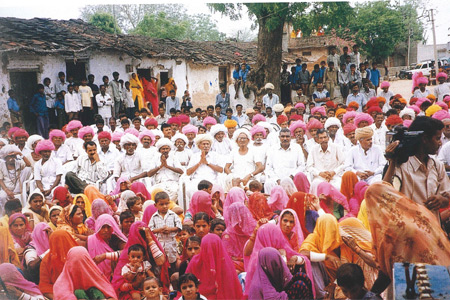
Villagers at a Function on Completion of their Water Harvesting Structure
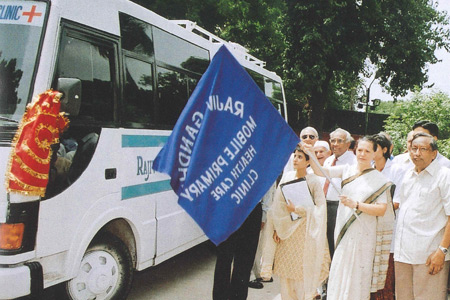
Smt. Sonia Gandhi inaugurating the Rajiv Gandhi Mobile Primary Healthcare Clinic
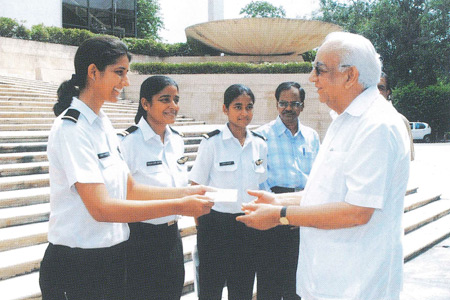
Scholarships of Rs. 2 lakhs each were provided to two meritorious women undergoing training for a pilot license at IGRUA
Red Ribbon Express
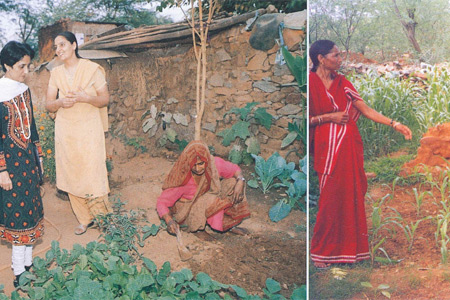
Promoting Herbal and Kitchen Gardens for Treatment
Project REACH
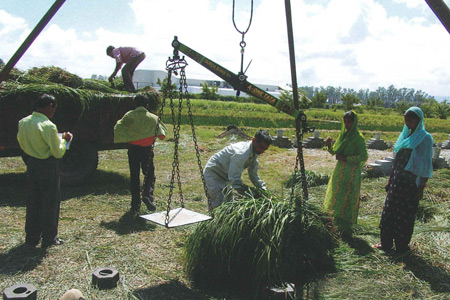
Farmers Weighing their Harvest of Lemon Grass
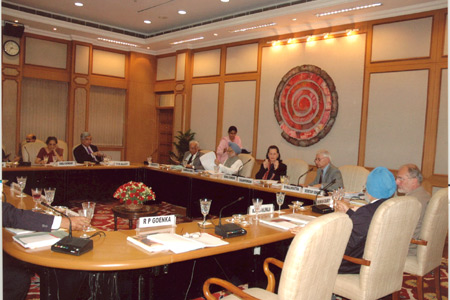
Annual Board Meeting of Trustees
7th Dr. Mahbub ul Haq inter school debate
2005-2006
Earthquake relief in Jammu & Kashmir:
The distribution of relief materials was done intensively in the immediate aftermath of the earthquake and continued for several months; a series of programmes for children was also initiated
Women and child development:
Women and sanitation: a two-day workshop was organised at the Foundation
Child support programmes INTERACT-I and INTERACT-II: a total of 56 children orphaned by acts of militancy were selected for financial assistance/li>
Tsunami relief and rehabilitation programmes
Poverty alleviation programmes such as Rajiv Gandhi Mahila Vikas Pariyojna were initiated: some income generation programmes for women were ginger processing, vegetable cultivation, bamboo cultivation, training in food processing, training in tailoring and sewing
Scholarship to women pilot trainees from Indra Gandhi Rashtriya Uran Akademi (IGRUA)
Natural resource management:
19 water-harvesting structures completed in Rajasthan
Project on ‘strengthening local governance of natural resources in Rajasthan’ initiated with three Panchayats of Jaipur district
14 training and exposure visits organised for field workers and community members
18 water-harvesting works, 12 gabion structures and 12,813 running meters of boulder bund constructed
Health:
AIDS/HIV programme:
In the North-East, 120 general practitioners and 80 NGO representatives trained on prevention, control and management of HIV/AIDS
In Delhi, 40 local healthcare providers and 15 youth groups trained on HIV/AIDS and STIs
In Maharashtra, Rajiv Gandhi Mobile AIDS Counselling Services expanded to Solapur, Pune
In order to empower women and adolescents, parenthood campaign initiated in Kurukshetra district, Harayana to improve the declining sex ratio
19,008 people were examined under the TB control programme
Education and literacy:
1,322 village and slum libraries were established in 21 states
Kashmir initiative for quality education trained 120 teachers from 12 districts of Jammu & Kashmir with the partnership of the Sarva Shiksha Abhiyan (SSA).
Building as a Learning Aid (BaLa) initiated in order to promote child-friendly school-building designs for government elementary schools with SSA
23 books in Hindi and six other languages were printed for children
Under Project EDGE, education and vocational training for 428 Muslim girls was undertaken
Disabled persons’ welfare:
Project Health Watch was held for prevention of causes of disabilities
Month-long Lifeline Express camps were organised in order to reach to disabled persons in rural areas
Mobility camps were organised in Odisha, Andhra Pradesh and Uttar Pradesh
Education and training for employment:
Entrepreneurial skills programme for disabled women was initiated; products made by them were marketed
Hearing aids were distributed to 30 children and five Braillers donated to two Delhi-based organisations working with the visually impaired
100 motorised vehicles for orthopedically challenged people were distributed
Science and technology:
Aromatic Plant Project, Dehradun, was started with 204 beneficiaries
Poverty alleviation through the promotion of agricultural micro enterprises in the aromatic plants sector
Gene campaigns were organised for sustainable food production, secure livelihoods and ecological security
Scholarships:
Rajiv Gandhi Travelling Scholarship Programme
Cambridge Scholarships and Bursaries
Rajiv Gandhi Science Talent Research Fellowship
Rajiv Gandhi Institute for Contemporary Studies (RGICS):
RGICS organised several seminars and other public events during the period of April 2005 to March 2006
RGICS, in association with PRIA, organised a national seminar to discuss the present status of the State Finance Commission; participants included Dr C. Rangarajan, Prof. Abhijit Sen and many more esteemed personalities
RGICS worked on papers on the ‘Impact of Sanitary Measures on Exports of Fishery Products from India: The Case of Kerala’ and ‘An Analysis of Severance Pay Policies in India and Sri Lanka’.
RGICS publications included ‘Economic Freedom for States in India 2005’ and ‘Land Use By the Poor in Delhi: Issues of Fuzzy Ownership’
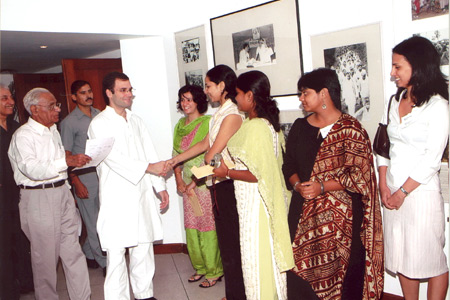
Our Trustee Shri Rahul Gandhi meeting the Cambridge Scholars
Income Generation Programme for Women in Bokaro
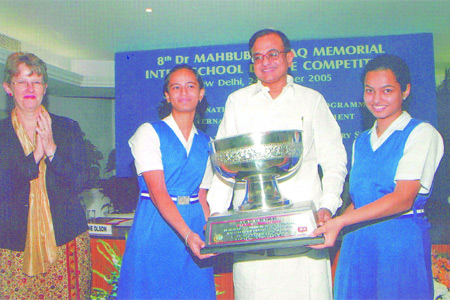
Our Trustee Shri P Chidambaram presents the best school award to Carmel Convent – Chandigarh
Earthquake relief programmes in Jammu and Kashmir
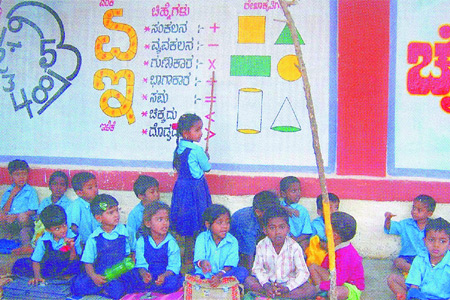
A school boundary wall and plinth become learning aids for mathematics
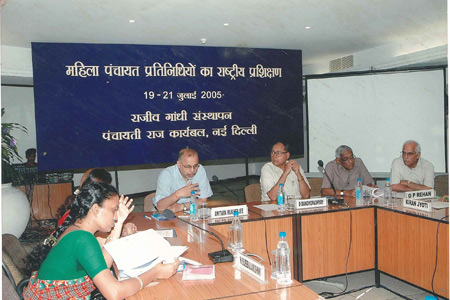
Panchayati Raj 2005
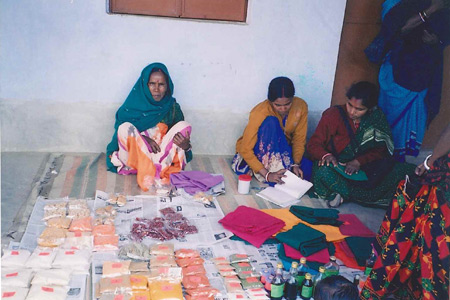
Sewing Unit- Income generation programme for women
Ice breaking exercises for children’s workshop in a library in rural Ahmedabad
2006-2007
Natural resource management:
A Kissan Sammelan was organised in the remote villages of the Dang area
12 new water-harvesting structures were built in 11 villages
A watershed project started in Bidar district
Literacy and education:
A meeting entitled ‘Towards Child Centred Quality Education in J&K’ was organised in Jammu in April 2006 to review the quality of education
A series of five workshops titled ‘Discovering Srinagar’ was organised.
A creative-writing workshop was organised for budding writers which was graced by 25 authors and inaugurated by the vice chancellor of Kashmir University, Prof. Abdul Wahid
A children’s film festival was held at Tagore Hall, Srinagar; 10 national and international award-winning films were screened
As part of Project Darakht-E-Ilm, 10 young teachers from the locality conducted classes in different mohallas of Jogeshwari in Mumbai
Women and child development:
A three-day workshop was held for children in Manipur, with sessions on music, dance, mime show and yoga; it was followed by a brief session on career guidance
A three-day residential workshop was held for tsunami-affected children of the Andaman and Nicobar Islands; the children thoroughly enjoyed relay, sack, and lemon-and-spoon races as well as painting
Health:
The Smart Parenthood campaign was initiated in five blocks of Kurukshetra district in Haryana to improve the declining sex ratio by empowering women and adolescent girls
A comprehensive, five-day interactive workshop was held for empowering out-of-school adolescents with life skills
Disabled persons’ welfare:
Two mobility camps organised in Uttar Pradesh and Jammu and Kashmir for providing the handmade artificial foot and lower limb prosthesis called the ‘Jaipur Foot’ to persons with locomotor disabilities
Science and Technology:
A field distillation unit was established and handed over to the farmers’ federation as part of the Aromatic Plants Project, Dehradun.
Memorial Lectures:
The Annual Rajiv Gandhi Science and Technology Lecture was delivered by Prof. Lord Martin Rees, Master of Trinity College, Cambridge, and President of the Royal Society.
Prof. Wangari Muta Maathai, the 2004 Nobel Laureate for Peace, delivered the Eighth Rajiv Gandhi Memorial Lecture in New Delhi.
Our Chairperson Smt. Sonia Gandhi awarding motorized tri wheelers to an awardee
RGF Trustee Dr. V Krishnamurthy presenting the awards to women pilots
A mime show by INTERACT children, Manipur
Girls performing at Culmination Function for ‘Discovering Srinagar’ and Children’s Film Festival
2007-2008
Natural resource management:
11 water-harvesting structures and one bawari were constructed in Jamwa Ramgarh block in Jaipur district
Innovative agricultural practices such as a sprinkler system were initiated and a ‘kisan mela’ was organised in Thali village to create awareness among farmers about innovative techniques
Non-formal education through Jeewanshalas was started in villages that do not have primary schools within 4–5 km
Education and literacy:
Under the library project, 53 new libraries were opened during this year; the programme also included recreational and literary activities, along with training of the librarians
Education of Muslim girls was emphasised through Project EDGE in Hyderabad and Project Darakh-E-Ilm in Mumbai
the Foundation also emphasised empowerment of Muslim girls and women through projects like Project Saksham, Project Chetna Kendra and the Quality of Education Programme.
Various projects like Project Vision were carried forward in order to preserve children’s rights
Kashmir initiative:
A community library was set up in Srinagar along with village libraries in Baramulla
‘Discovering Kashmir’ was a series of student workshops that was field-tested this year among students
Awards for creative writing were given
A children’s film festival was organised
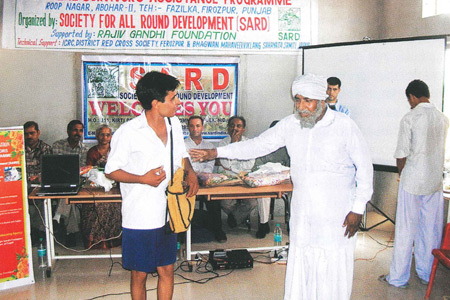
An integrated development project called Society for All Round Development (SARD) was launched in Rajasthan
Story telling workshops were held in Karnataka: 10 such workshops were held for around 4,645 librarians and teachers
The Vidya Gyan Scholarships were launched to reduce the number of school dropouts
Women and child development:
Project INTERACT: the Foundation supported the school education of 752 children and allowances of Rs 12,000 were made to meet the expenses
INTERACT II: the Foundation selected 19 children in 2007–08, taking the cumulative total to 42
Post-tsunami assistance was started which included child support programmes and workshops for tsunami-affected children of the Andaman and Nicobar islands
Child protection programmes such as Project REACH were initiated
Child Development Centres in Neemrana and Jodhpur were established.
Women’s development was undertaken through microfinance and capacity building in states like Orissa, Uttar Pradesh, Chattisgarh, Andaman and Nicobar Islands, Bihar, Rajasthan, and Jammu and Kashmir
Scholarships provided to 34 women cadets
Disabled persons’ welfare:
Self-reliance through mobility and medical rehabilitation: the Foundation provided 150 vehicles to orthopedically challenged individuals with the help of our donors
Lifeline Express camps and mobility camps were held, and Project Health Watch was launched with the motive of empowering physically challenged people
Educating, training and employing physically challenged women was achieved through promotion of screwpine crafts and oyster mushroom cultivation
Health:
Rajiv Gandhi Mobile AIDS Counselling Services (RGMACS): in Mumbai, 50,000 people were reached through exhibitions, 7,652 persons were counselled in groups and 2,901 individually
Several other health initiatives like Save the Kidney Initiative, Health for All, Smart Parenthood campaign, Red Ribbon Express, Community Aid Support and dental camps were organised with success
Science and technology:
A bio-resource conservation project was initiated with the aim of promoting sustainable agricultural practices; use of plant-based pesticides was encouraged
Under the Aromatic Plant Cultivation and Processing project, various workshops were organised to create awareness among farmers
Scholarships:
Scholarships like the Rajiv Gandhi Travelling Scholarships Programme, Rajiv Gandhi Science Talent Research Fellowships, and Cambridge Scholarships and Bursaries were taken forward
Rajiv Gandhi Institute for Contemporary Studies (RGICS):
A new, independent website was created at www.rgics.org which and is horizontally linked to the Foundation’s main website (www.rgfindia.com).
Focus on international economic relations was emphasised, with discussions on implications of SPS and TBT agreements on access to health
Other RGICS initiatives in 2007–08:
RGICS Post-doctoral Fellowship
India–China Studies
Dr Mahbub ul Haq Memorial Inter School Debate Competition was held
Publications during the reporting period included ‘Women Rights: Access to Justice’, ‘Economic Freedom in India and China’ and ‘Reflections—People’s Forum, 2007’.
Working papers were produced on ‘Tribal Welfare Through Panchayats: The Experience of PESA in Orissa’
SAARC Inter-school debate
Red Ribbon Express being flagged-off, New Delhi
READ professionals interacting with students on hygiene, Tumkur
Girls performing at Culmination Function for ‘Discovering Srinagar’ and Children’s Film Festival
A Vidya Gyan scholar receiving her first bank draft
A library in Ahmedabad
INTERACT-Activities
Dental Camp, Amethi
2008-2009
Education and literacy:
Under the village and slum libraries project, 52 new libraries were established in Bihar, 10 in Bilaspur and 24 libraries in Uttar Pradesh
Project EDGE in Hyderabad was launched to support four educational centres for adolescent girls.
Project Darakht-e-Ilm was initiated to provide educational support to young girls and women from Muslim dominated areas.
Project Vision in Varanasi, Integrated Development Project in Rajasthan and Project Chetna Kendra in Rajasthan was launched.
Kashmir initiative for quality education. A manual for teachers relevant for the entire valley titled, ‘Discovering Kashmir’ was prepared.
Children’s Film Festival was a four-day event organised in month of March in 2009. Besides, awards for Creative Writing were instituted in year 2008-09.
Scholarships:
INTERACT I and INTERACT II was taken forward and 1697 children had been supported by the Foundation under this programme.
The Foundation also supported children affected by riots and assisted post-tsunami victims.
Vidyagyan Scholarship Programme was initiated in order to reduce school dropouts among Dalit and Muslim girls.
Rajiv Gandhi Travelling Scholarships and Cambridge Scholarships and Bursaries.
Women and child development:
Child protection programme:
Project REACH in Madhya Pradesh
Child development centre in Rajasthan
Poverty-alleviation initiatives for the education of the girl child were undertaken in Manipur
Women’s empowerment through microfinance and capacity building:
Rajiv Gandhi Mahila Vikas Pariyojna in Uttar Pradesh
Livelihood Programme for Women through Vegetable Cultivation in Uttarakhand
Capacity-building programme through training in food processing in the Andaman and Nicobar Islands
Project Swabalambini in Uttar Pradesh
Livelihood project for Musahar women through bamboo crafts in Bihar
SHG formation and skill development among women of the Baiga tribe in Chhattisgarh
Health and disability:
Promotion of mobility:
Motorised vehicle distribution for orthopedically challenged individuals: 100 individuals were given vehicles with the aid of our donors
Mobility camps were organised to provide artificial limbs and other assistive devices to people with disabilities
Education, training and employment:
Early intervention programme for hearing-impaired children
Manufacture and marketing of screwpine crafts
Access: Promoting a disabled-friendly environment through the Accessible Delhi Project
Lifeline Express camps
Awareness and management of HIV/AIDS
Awareness and advocacy for the inclusion of persons with disability
Legal literacy on disability issues and Project Health Watch
Community-based rehabilitation of the disabled, which included the Landmine Survivors’ Assistance Programme
Save the Kidney initiative, Red Ribbon Express and mobile tuberculosis clinic in Himachal Pradesh
Natural resource management:
Strengthening local governance of natural resources
Improving livelihood options, which included enhancing agricultural production through soil and water conservation
Innovative agricultural practices such as demonstrative farms, horticulture units, farm ponds and water-saving techniques were incorporated
Water-harvesting initiatives in Karoli and Pali districts
Watershed development was initiated in Rahir village, Sapotra block, Karoli district
Rajiv Gandhi Institute for Contemporary Studies (RGICS):
International economic relations:
Two conferences, one in New Delhi and other in Beijing, were conducted; the first conference was on ‘Exploring Synergies in Trade and Investment’ and the second concentrated on financial issues
The institute carried out the following studies:
Economic Freedom Index for the States of India
Intellectual Capital in India: Contribution of States
Other annual activities such as the RGICS Post-doctoral Fellowship, India–China Studies and Dr Mahbub ul Haq Inter School Debate continued.
Pustak Yatra in Jodhpur
Girls reading books at village library
Education and Literacy
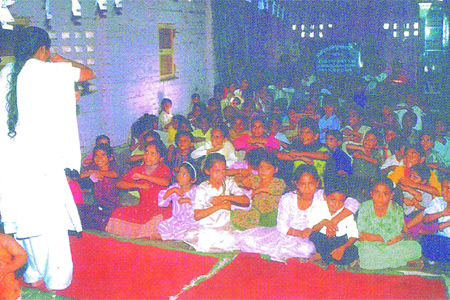
Children learning yoga at an INTERACT workshop in Andhra Pradesh
A class in progress at Jeewanshala in Karoli
Mine Risk Education Workshop in progress
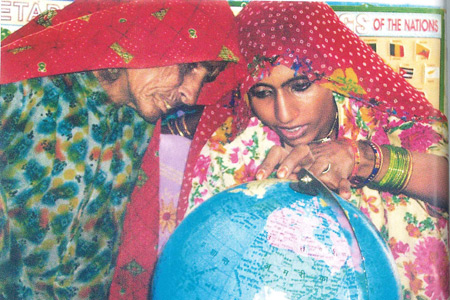
Elderly women trying to locate India on a globe at a village library
2009-2011
Education and literacy:
‘Nukkad natak’ was performed and posters were created to dramatise the problems of gambling
The Child Development Centre of Neemrana organised health awareness camps and offered regular mid-day meals
A leadership workshop was conducted by actor Averee Chaurey and singer Amrita Das for 55 girls in Varanasi
30 Jeevanshalas were run
Nine new Children’s Learning Centres (CLCs) were set up
The first three-day workshop for INTERACT children held in Assam
A three-day teacher-training programme was organised in Lucknow
RGTSP awarded scholarships to 20 students from British universities in 2009–10 and to 19 students in 2010–11.
Health and disability:
The Foundation supported the Akshar Trust in Vadodara, Gujarat, in a project for children with hearing impairment
Lifeline Express organised two camps in West Bengal and Bihar
200 motorised tri-wheelers were awarded in 2009–10 and 150 in 2010–11.
Natural resource management:
53 new water-harvesting structures were built in 2009–10
Two breeding centres were operated in 2009–11 in partnership with BAIF
Rajiv Gandhi Institute for Contemporary Studies (RGICS):
On December 9, 2009, a national seminar on the rule of law in India took place at Jawahar Bhawan as the culmination of the project ‘Rule of Law in India, Phase I’; the seminar was inaugurated by the Union Minister of Law and Justice, Dr M, Veerappa Moily
A project on ‘Trade Facilitation in South Asia’ was supervised by RGICS Associate Director Dr P.D. Kaushik
RGICS Fellow Mohammad Saqib carried out a feasibility study on ‘India–China: Free Trade Agreement (FTA)’
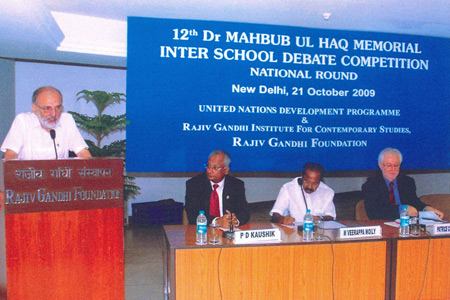
The 12th Dr Mahbub ul Haq Inter School Debate was organised on ‘Corruption puts the brakes on development; women suffer the consequences’
The Milton Friedman inter-college debate hosted by the Miranda House Debate Society, University of Delhi on the topic ‘Markets eliminate inequalities’
12th Dr. Mahubub ul Haq Memorial Inter-school debate
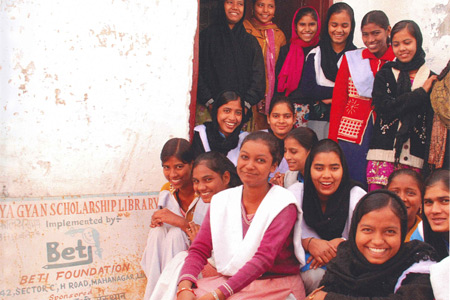
Focus on the girl child Vidyagyan Scholarship Programme
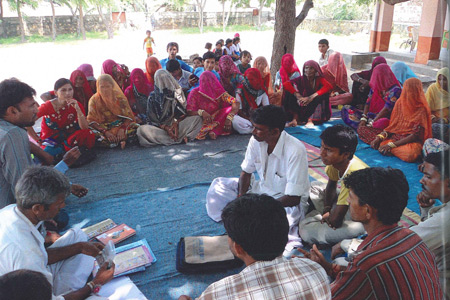
Decentralisation of Education Governance
2011-2012
Transformative learning:
Parent–teacher meetings and teacher training workshop held
Wonderoom set up at Jawahar Bhawan
In 2011-12, the Foundation team visited some of the Access to Opportunities awardees from the previous year and came face-to-face with inspiring stories that make the programme so worthwhile.
The Foundation started a helpline to provide an ambulance service during emergencies so that pregnant women could avail advantages of institutional delivery.
Rajiv Gandhi Institute for contemporary Studies:
On October 19, 2011, the RGICS 20th Anniversary Lecture on the theme of ‘Globalisation, Justice and Rights’ was delivered by an esteemed panel.
A brainstorming session on the project ‘Regional Development in India: A Critical Evaluation’ was organised at RGICS
INTERACT – Access to Opportunities
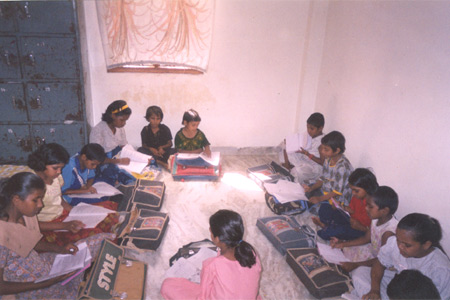
Children Learning Centres
2012-2013
Decentralisation of Education Governance (DEG) initiative:
In the district of Chitrakoot, three follow-up workshops were held to demonstrate the possibility of community involvement in bringing about a change in schools
A web-based application providing access to LEGD schools was activated
Transformative Learning (TL):
Orientation sessions were held for teachers in different districts of Andhra Pradesh wherein the teachers discussed the socio-economic background of students and the lack of constructive links between the students’ world and their schooling
The Foundation team visited Shillong to discuss Continuous Comprehensive Evaluation (CCE)
A language development programme was conducted for the Wonderoom by Ms Sonya Philip, who specializes in learning disabilities
Children’s Learning Spaces (CLS), called Vistaar, were conceptualized to address the gaps in formal schooling and strengthen children’s learning abilities
INTERACT
The Access to Opportunities programme was initiated in 1992 to enable physically challenged individuals to improve their mobility; it started by awarding one motorbike in its first year and reached 450 vehicles in 2012
The Foundation associated itself with organisations in around 18 states
Young Scholars’ Leadership Programme (YSLP): One of the key initiatives of the Foundation, YSLP had been supporting children affected by conflict across the country since 1993; by this year, it had reached out to approximately 1,700 children
Vidyagyan Scholarship Programme: The basic aim of initiating this programme was to shift the attitude of society towards girls’ education
The Teacher Empowerment Programme:
This was initiated in order to improve the current status of education in India in the north-eastern region of the country, establishing base at Guwahati in Assam
Action research on DIET (District Institute of Education and Training): a diploma in elementary education was offered through the government-run DIETs in Assam (only 18 of the states and 27 districts have a DIET)
A training management system was developed for secondary school teachers in Mizoram
Support was provided to the SSA Meghalaya in developing a training module for head teachers through consultations and workshops
Inputs were provided to the SCERT, Manipur, and an exploratory visit made to the SCERT, Nagaland
Natural resource management:
Construction of water-harvesting structures was taken forward: 31 structures were planned, out of which 28 were constructed
School education programmes were initiated in regions where education facilities were virtually non-existent: in 2012–13, a total of 184 children were enrolled in schools
To promote health of mother and child, emergency ambulance service was initiated
Rajiv Gandhi Institute for Contemporary Studies (RGICS):
RGICS’s main focus during this year was to enhance the capacity of political leaders and social movements
Public awareness of public policy was widened
Public officials sensitised towards democratisation of public policy
Policy research assistance provided to MPs
Weekly newsletter ‘Policy Watch’ started
When Wonderoom comes alive
Transformative Learning Programme
Teacher Empowerment Programme
Facilitating community engagement
Children at CLS Deenapur engaged in learning group task
Access to Opportunities
2013-2015
Transformative learning:
In 2013–14, the Foundation entered into formal agreements with the states of Chhattisgarh and Uttar Pradesh, in addition to the existing agreements with Andhra Pradesh, Bihar, Meghalaya and Uttarakhand
In all the clusters, district-level meetings were organised; workshops were planned for Block Resource Centre Coordinators and Cluster Resource Centre Coordinators in all the states where the processes were being implemented
In November 2014, Sarva Shiksha Abhiyan (SSA), in collaboration with Rajiv Gandhi Foundation, organised a review and sharing meeting with the government functionaries of SSA in Meghalaya
Introductory and training workshops were conducted with head teachers and teachers, discussing the National Curriculum Framework 2005, Right to Education 2009 and various aspects of the Transform Schools approach
The Foundation started the monthly teachers’ collectives in all clusters in July 2013; approximately 4,050 teachers attended these collectives regularly
During the reporting year, two members from the NCERT also visited the clusters and engaged with the MEOs, HMs and teachers to understand the processes by which Continuous Comprehensive Evaluation (CCE) was being implemented at the school level
A series of eight sessions were held by Jodo Gyan in the Foundation’s premises, which focussed on how children could be enabled to understand number concepts through fun activities and apprentice learning techniques
A summer camp was organised at the Wonderroom during May and June with the theme ‘Explore Your Talent’; nearly 750 children participated in 2013–14 and 180 children in 2014–15.
The Wonderoom collaborated with New Delhi Municipal Corporation (NDMC) in 2013–14 to implement some child-centric projects in schools in the vicinity
The Wonderoom initiated two children’s clubs, Expresso Club and Ados-Pados Club, to enable self-exploration through activities and media such as theatre and the fine arts
The Educational Ecosystem Project, launched in the Rae Bareli and Amethi districts of UP, focussed on creating a Children’s Learning Space (CLS), also called Vistaar
277 specialised vehicles were awarded to youth with physical disabilities in 2013–14 and to 150 people in 2014–15
Under the Young Scholars Leadership Initiative, 523 scholars were supported in 2013–14 and 490 scholars were supported in 2014–15
In 2013–14, 500 young girls were enrolled under VidyaGyan programme
The Rajiv Gandhi Foundation initiated a pilot project in the Barabanki and Rae Bareli district libraries in September 2013, with a grant from the Gates Foundation
A leadership module was developed for the participants of the INTERACT programme
Decentralisation of education governance:
At the gram panchayat level, meetings were organised with members of the Education Standing Committees
The gram panchayat of Dadiya Rampur provided computers to its students in five schools
In Daundh block, the Block Standing Committee visited 20 schools for observation on a regular basis
In 2013–14, a total of 2,891 processes was organised by Prajayatna in the various districts of Uttar Pradesh
In Rae Bareli, a proposal for the construction of the anganwadi centre in Unchahaar block’s Kotara Bahadurgunj was mooted during the gram panchayat network follow-up meeting; land for the same was obtained and the construction of the centre begun.
Teacher empowerment:
In June 2013, support was also extended to DIET Jorhat for developing the school internship component of the D.El.Ed. course and for using group work as a teaching strategy
The Foundation supported the National University of Education Planning and Administration (NUEPA) towards establishing a chair titled the Rajiv Gandhi Foundation Chair for Teacher Development and Management
In 2013–14, NUEPA initiated a national study to analyse the ‘Working Conditions of Teachers’
In 2013–14, the Foundation was invited to be a part of the research team for the study on ‘Working Conditions of Teachers’ for the state of Mizoram by the Institute of Advanced Studies in Education (IASE), Aizawl
Natural resource management:
In the village of Maharajpura, a 700m diversion channel was constructed, which increased the catchment area by 4 sq. km, resulting in an increased area being brought under cultivation and assured irrigation for two seasonal crops
In 2014–15, the Gram Gaurav Sansthan partnered with NABARD to construct 13 pagaras (water-harvesting dams) in five villages
In 2014–15, 445 kg of seeds were provided to farmers
The Gram Gaurav team worked round the clock for 10 days and provided food, medicines, blankets and water to the flood victims during the Kashmir floods
Rajiv Gandhi Institute for Contemporary Studies (RGICS):
Several series of monthly seminars were organised in Guwahati and Assam for members of political youth organisations, on significant socio-economic issues such as the Food Security Bill, the National Food Security Ordinance, and women’s rights
In the period April 2013–March 2015, 80 Policy Watch issues were published and disseminated to political representatives, including a special edition for the 50th issue
A training programme was organised for the second batch of RG-RALs to give them an overview of the vision and mission of the organisation and direction on their roles and responsibilities
The Institute was represented by INET president Robert Johnson, also a senior fellow and director of the Global Finance Project, Franklin and Eleanor Roosevelt Institute, New York, and by Dr Erik Berglof, then chief economist, European Bank for Reconstruction and Development (EBRD)
Wonderoom Comes Alive
Teacher Empowerment Programme
Shikshan Gram Sabha
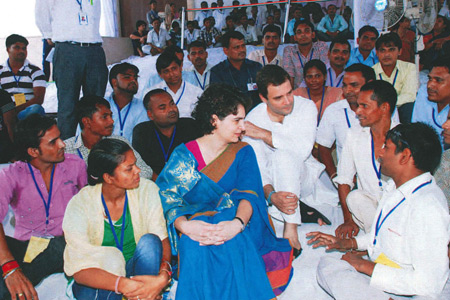
Shri Rahul Gandhi and Smt Priyanka Gandhi Vadra talking to disable people under Access to Opportunities Initiative